

Identifying Common Apparel Inventory Mistakes in Fashion Retail
In the fast-paced world of fashion retail, effective apparel inventory management strategies are crucial for business success. Whether you operate a small boutique or manage a large warehouse distribution center, inventory mistakes can significantly impact your bottom line, customer satisfaction, and operational efficiency. The apparel industry faces unique challenges due to the wide variety of products, multiple size and color combinations, seasonal fluctuations, and rapidly changing trends. Understanding these common pitfalls is the first step toward implementing solutions that protect your business from costly inventory errors while maintaining optimal stock levels.
Inventory miscounts represent one of the most prevalent issues in apparel retail, often stemming from manual processes and human error. When physical inventory doesn’t match system records, businesses face a cascade of problems including unexpected stockouts, overstocking, and financial discrepancies. For fashion retailers, these inaccuracies are particularly problematic as they manage thousands of SKUs across multiple seasonal collections, styles, sizes, and colors. The complexity multiplies when considering omnichannel operations where inventory needs to be tracked across physical stores, warehouses, and e-commerce platforms simultaneously.
The consequences of poor inventory management extend far beyond mere operational inconvenience. Stockouts can lead to lost sales opportunities, damaged customer relationships, and diminished brand loyalty when shoppers cannot find their desired items. On the flip side, overstocking ties up capital in excess merchandise, increases storage costs, and often results in margin-eroding markdowns when seasonal items fail to sell. For fashion retailers operating on tight margins, these inventory mistakes directly impact profitability and can threaten business sustainability in an already competitive market.
Industry research reveals the magnitude of these issues, with fashion retailers typically experiencing inventory accuracy rates of only 60-80%, significantly lower than the 95-98% benchmark for optimal performance. This accuracy gap translates to approximately 30% of inventory being effectively “dead stock” – items that remain unsold due to poor inventory visibility and management. By identifying these common apparel inventory mistakes and implementing targeted solutions, retailers can transform inventory management from a liability into a strategic advantage that supports growth and profitability.
The Role of ERP and WMS in Apparel Inventory Management

WMS) have revolutionized apparel inventory management strategies by providing comprehensive, integrated solutions for tracking, managing, and optimizing inventory across the supply chain. These sophisticated platforms serve as the technological backbone for fashion retailers seeking to eliminate common inventory mistakes through automation, data centralization, and real-time visibility. By replacing fragmented, manual processes with integrated systems, apparel companies can achieve unprecedented accuracy in their inventory operations while simultaneously improving efficiency and reducing operational costs.Enterprise Resource Planning (ERP) and Warehouse Management Systems (
ERP systems consolidate critical business functions—including inventory management, purchasing, sales, and financial reporting—into a single platform, creating a unified data environment that eliminates silos between departments. For apparel retailers, this integration means that inventory data is consistently updated across all channels and locations, providing a single source of truth for stock levels, product locations, and movement patterns. When a customer purchases a red dress in size medium from a physical store, the same item is instantaneously removed from available inventory across all sales channels, preventing duplicate sales and the customer disappointment that results from selling products that are no longer available.
Warehouse Management Systems complement ERP functionality by providing specialized tools for optimizing warehouse operations specific to apparel inventory management. WMS platforms excel at directing and tracking the physical movement of inventory within storage facilities, from receiving and putaway to picking, packing, and shipping. For apparel retailers managing thousands of SKUs with multiple size and color variations, WMS capabilities such as barcode scanning, RFID tracking, and directed picking routes significantly reduce errors while increasing operational throughput. These systems also provide enhanced visibility into inventory location and status, enabling more efficient space utilization and labor allocation within the warehouse environment.
The integration between ERP and WMS creates a powerful technological framework that addresses many common apparel inventory mistakes. When properly implemented, these systems provide real-time inventory visibility, automated replenishment, accurate demand forecasting, and detailed analytics that support data-driven decision-making. For instance, integrated platforms can automatically flag inventory discrepancies for investigation, suggest optimal reorder points based on sales history and lead times, and provide early warnings for potential stockouts or overstock situations. By leveraging these technological capabilities, fashion retailers can transform their inventory management from a reactive, error-prone process into a strategic advantage that enhances customer satisfaction and drives business growth.
Inadequate SKU Management and Its Consequences
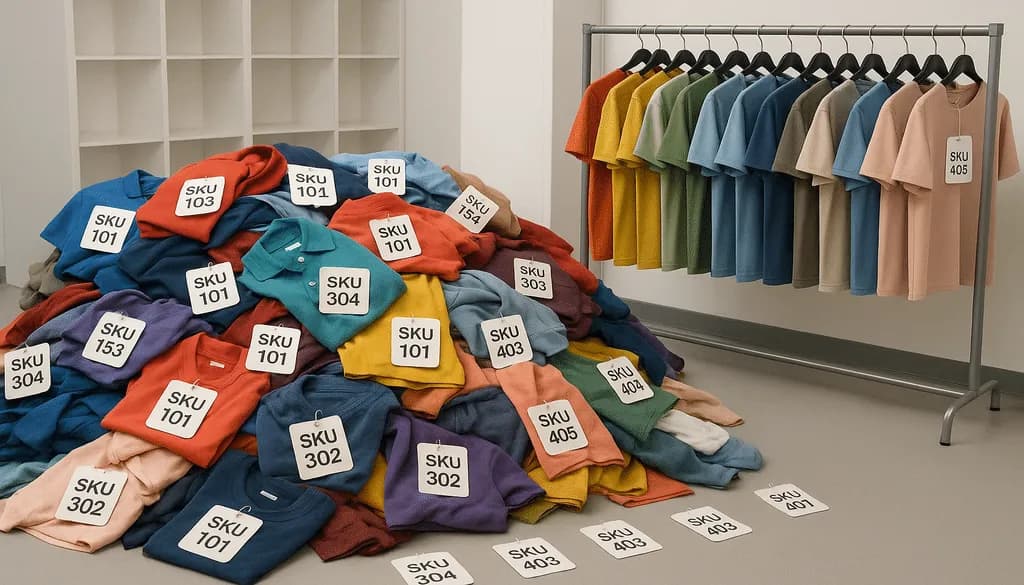
Precise Stock Keeping Unit (SKU) management forms the foundation of successful apparel inventory management strategies, yet many fashion retailers struggle with this fundamental aspect of their operations. In an industry where products are differentiated by intricate combinations of style, size, color, fabric, and season, inadequate SKU management creates a ripple effect of problems throughout the entire supply chain. Each variation of a product must be assigned a unique identifier that accurately reflects its specific attributes, enabling precise tracking and management from production to point of sale. When this system breaks down due to inconsistent naming conventions, duplicate SKUs, or inadequate attribute tagging, the consequences can be severe and far-reaching for apparel retailers.
The complexity of apparel SKU management becomes evident when considering the exponential nature of product variations. A single style of women’s blouse available in 5 colors and 8 sizes creates 40 distinct inventory items, each requiring separate tracking and replenishment. Multiply this across hundreds or thousands of styles in a typical fashion retailer’s catalog, and the potential for SKU management errors increases dramatically. Common mistakes include inconsistent naming conventions, failure to properly retire discontinued items, creating duplicate SKUs for identical products, and inadequate attribute tagging that prevents effective filtering and searching. These seemingly minor errors accumulate over time, creating a progressively less reliable inventory management system that frustrates both customers and staff.
The consequences of poor SKU management extend far beyond mere administrative headaches. When inventory systems contain inaccurate or duplicate SKUs, order fulfillment accuracy declines as warehouse staff struggle to identify the correct products. This leads to shipping errors, customer returns, and damaged brand reputation. Merchandising decisions suffer when planners cannot accurately analyze sales performance due to split data across duplicate SKUs or inconsistent categorization. Perhaps most critically, inventory visibility becomes distorted, leading to incorrect purchasing decisions, unnecessary stock transfers, and increased carrying costs as safety stock levels rise to compensate for the lack of reliable inventory data.
Best practices for apparel SKU management include implementing standardized naming conventions that follow a logical, consistent pattern across all product categories. Comprehensive attribute tagging allows for detailed classification and searching, making it easier to identify specific items within the inventory system. Regular SKU audits help identify and merge duplicates, retire obsolete items, and ensure data integrity across all systems. Additionally, investing in product information management (PIM) solutions that integrate with ERP and WMS platforms creates a synchronized ecosystem where SKU data remains consistent throughout the product lifecycle. By establishing robust SKU management practices, fashion retailers can eliminate a significant source of inventory errors while improving operational efficiency and enhancing the customer experience.
Poor Demand Forecasting and Seasonality Challenges
The fashion industry’s inherent seasonality and rapidly changing trends make accurate demand forecasting particularly challenging for apparel retailers. Unlike staple consumer goods with relatively stable demand patterns, fashion merchandise experiences dramatic fluctuations influenced by seasons, trends, weather variations, and social factors. Many retailers struggle to align their inventory with actual customer demand, resulting in either missed sales opportunities due to stockouts or margin erosion from excessive markdowns on overstock. These forecasting challenges represent one of the most significant apparel inventory management hurdles that businesses must overcome to remain competitive in today’s market.
Seasonal transitions create particularly acute forecasting challenges as retailers must predict not only the volume of sales but also the timing of demand shifts. Introducing spring collections too early or holding winter merchandise too long can result in significant financial losses and storage inefficiencies. Climate variability further complicates these predictions, as unseasonable weather can dramatically impact the sales performance of weather-sensitive apparel categories. A warm autumn can devastate sales projections for outerwear, while an extended winter might suppress demand for spring merchandise. Without sophisticated forecasting tools and methodologies, retailers often resort to historical averages that fail to account for these variables, leading to inventory imbalances across their product assortment.
Fashion trend volatility adds another layer of complexity to apparel demand forecasting. Social media and celebrity influence can rapidly accelerate or diminish demand for specific styles, colors, or design elements, creating sudden inventory shortages or surpluses that traditional forecasting methods cannot anticipate. Fast fashion retailers have recognized this challenge by developing responsive supply chains and production processes, but many traditional apparel companies still operate with lengthy lead times that require accurate long-range forecasting. This disconnect between planning horizons and market reality frequently results in inventory mistakes that impact both financial performance and customer satisfaction.
Advanced analytics and data science offer promising solutions to these forecasting challenges by incorporating multiple variables beyond basic historical sales data. Modern forecasting approaches leverage artificial intelligence and machine learning algorithms to analyze diverse datasets including social media trends, weather patterns, economic indicators, and competitor activities. These sophisticated models can detect emerging patterns and correlations that human analysts might miss, providing more accurate and nuanced demand projections. Additionally, implementing shorter planning cycles with more frequent reassessments allows retailers to adjust their inventory strategies as actual sales data emerges, reducing the impact of initial forecasting errors. By embracing these advanced forecasting methodologies, apparel retailers can significantly improve their inventory management accuracy while enhancing their responsiveness to market changes.
Actionable Strategies to Avoid Apparel Inventory Errors

Implementing regular inventory auditing schedules represents a foundational strategy for minimizing apparel inventory mistakes. Rather than relying solely on annual physical counts that disrupt operations and provide only periodic accuracy snapshots, progressive fashion retailers have adopted cycle counting programs that verify inventory accuracy continuously throughout the year. This approach involves counting a subset of inventory each day or week according to a predetermined schedule, ensuring that all items are verified multiple times annually without operational disruption. High-value or fast-moving items can be counted more frequently, while stable inventory may require less frequent verification. Systematic cycle counting not only improves inventory accuracy but also helps identify recurring problems, allowing management to address root causes rather than merely correcting individual discrepancies.
Staff training and accountability form crucial components of error prevention in apparel inventory management. Many inventory mistakes stem from inconsistent processes, misunderstood procedures, or simple human error during receiving, putaway, picking, or shipping operations. Comprehensive training programs should cover not only the technical aspects of inventory systems but also emphasize the broader impact of inventory accuracy on business performance and customer satisfaction. Creating a culture of accountability where employees understand how their individual actions affect inventory integrity encourages attention to detail and process adherence. Some retailers have successfully implemented accuracy metrics as part of performance evaluations, recognizing and rewarding staff members who contribute to improved inventory accuracy through careful attention to established procedures.
Technological solutions provide powerful tools for preventing common apparel inventory mistakes through automation and enhanced visibility. Barcode scanning and RFID technologies dramatically reduce manual data entry errors by capturing product information automatically during receiving, movement, and shipping processes. Mobile inventory management applications enable staff to verify and update inventory information directly from the warehouse floor, eliminating paper-based processes that often introduce errors through transcription mistakes or delayed updates. Real-time inventory visibility across all sales channels prevents overselling by ensuring that available quantities reflect the latest transaction data from both online and physical store locations. Additionally, automated reordering systems can maintain optimal stock levels by triggering purchase orders when inventory reaches predetermined thresholds, preventing both stockouts and excess inventory situations.
Data integration across systems represents perhaps the most transformative strategy for eliminating apparel inventory errors at scale. When ERP, WMS, e-commerce platforms, and point-of-sale systems share consistent, real-time inventory data, many common mistakes simply cannot occur. This integration eliminates manual transfers between systems, prevents data silos that lead to visibility gaps, and ensures that all business functions operate from the same inventory information. Modern API-based integration approaches make it increasingly feasible to connect even disparate legacy systems, while cloud-based platforms offer native integration capabilities that simplify this process. For fashion retailers managing complex product assortments across multiple channels, this system cohesion provides the foundation for inventory accuracy that supports business growth and enhances customer satisfaction through reliable product availability.
Conclusion
Implementing effective apparel inventory management strategies is no longer optional for fashion retailers—it’s a competitive necessity in today’s challenging retail landscape. The inventory mistakes we’ve explored—from basic counting errors to complex forecasting challenges—create significant obstacles to profitability, operational efficiency, and customer satisfaction. By recognizing these common pitfalls and implementing targeted solutions, apparel retailers can transform inventory management from a persistent problem into a strategic advantage that supports business objectives and enhances market position.
Technology adoption stands at the center of modern inventory improvement efforts. The integration of ERP and WMS platforms creates a unified data environment that eliminates many traditional inventory errors through automation, validation, and real-time visibility. When combined with advanced forecasting tools that incorporate multiple variables beyond basic sales history, these systems provide the technological foundation for inventory excellence. However, technology alone cannot solve inventory challenges without corresponding process improvements and staff development initiatives that ensure consistent implementation and utilization across the organization.
The financial implications of improved apparel inventory management are substantial. Industry research indicates that retailers who achieve high inventory accuracy typically realize 4-8% sales increases through better product availability while simultaneously reducing inventory carrying costs by 10-15% through more precise stocking levels. These financial benefits accumulate over time as improved inventory data supports better merchandising decisions, more efficient warehouse operations, and enhanced customer experiences that drive loyalty and repeat purchases.
For fashion retailers looking to improve their inventory operations, the journey begins with an honest assessment of current capabilities and limitations. Identifying your most significant inventory pain points—whether they involve basic accuracy issues, SKU management challenges, or forecasting difficulties—provides the foundation for targeted improvement initiatives. By prioritizing these efforts based on business impact and implementing solutions systematically, even organizations with limited resources can achieve meaningful improvements in their apparel inventory management strategies. The result is a more resilient, responsive, and profitable retail operation positioned for success in an increasingly competitive market.
Frequently Asked Questions (FAQ)
What is the most common inventory mistake in fashion retail, and how can it be prevented?
One of the most common inventory mistakes in fashion retail is inaccurate stock counts, which often result from manual data entry or lack of real-time tracking. This can lead to both stockouts and overstock situations, hurting sales and increasing costs. To prevent this, fashion retailers should implement automated inventory management systems like ERP or WMS platforms. These tools improve data accuracy, offer real-time visibility, and streamline replenishment processes, significantly reducing the risk of costly errors. Regular inventory audits and staff training further help maintain inventory accuracy over time.
How do seasonal trends affect apparel inventory management?
Seasonal trends create significant challenges for apparel inventory management due to their predictable yet variable nature. Fashion retailers must carefully balance having enough stock to meet seasonal demand without accumulating excess inventory that requires heavy markdowns. Effective management requires analyzing historical data alongside current trend forecasts and weather predictions. Advanced demand planning tools can help retailers phase in seasonal merchandise gradually while strategically reducing previous season items. Implementing a robust open-to-buy system that allocates purchasing budgets by time period helps maintain this balance, while flexible supplier relationships allowing for in-season reorders provide a safety net for unexpectedly popular items.
What technology solutions are most effective for improving apparel inventory accuracy?
The most effective technology solutions for improving apparel inventory accuracy combine automated data capture with integrated management systems. RFID technology has proven particularly valuable for fashion retailers, enabling quick, accurate counts without handling each item individually—some retailers report 99% inventory accuracy after RFID implementation. Barcode systems remain cost-effective for smaller operations, while computer vision and AI-based systems represent emerging technologies that can verify shipments and identify misplaced items. Cloud-based inventory management platforms that integrate with POS systems and e-commerce channels provide real-time visibility across all sales channels, preventing overselling and enabling accurate multichannel fulfillment. For maximum effectiveness, these technologies should be implemented alongside process improvements and staff training programs.
How can small fashion retailers with limited budgets improve their inventory management?
Small fashion retailers with limited budgets can significantly improve inventory management by implementing cost-effective solutions and process improvements. Cloud-based inventory management software with monthly subscription models provides sophisticated capabilities without large upfront investments. Establishing consistent receiving, counting, and reconciliation processes helps prevent common errors, even without extensive automation. Implementing ABC inventory classification to focus attention on high-value or fast-moving items ensures efficient use of limited resources. Regular cycle counting of small sections rather than disruptive full inventory counts maintains accuracy with minimal operational impact. Additionally, small retailers can leverage their agility advantage by conducting more frequent but smaller purchases, reducing both carrying costs and markdown risk while maintaining fresh merchandise assortments.
How should warehouses handle size and color variants in apparel inventory?
Implement SKU structures that clearly identify size, color, and style variants while maintaining parent-child relationships for reporting. Store variants together when possible to speed picking, but consider separate locations for extreme sizes with lower velocity. Use matrix views in your WMS for quick visibility into variant availability and implement automated reorder alerts at the variant level.